Critics of school choice often argue that Education Savings Accounts will “drain resources” from public schools, forcing cuts to teachers and core services.
But Iowa’s own data tells a more complicated story.
I recently analyzed school district data from the U.S. Department of Education’s Common Core of Data. It showed that many Iowa districts have already experienced enrollment declines over the past three decades. In some of the state’s largest districts, student populations have fallen by 10% to 25% from their peak levels. This is not news.
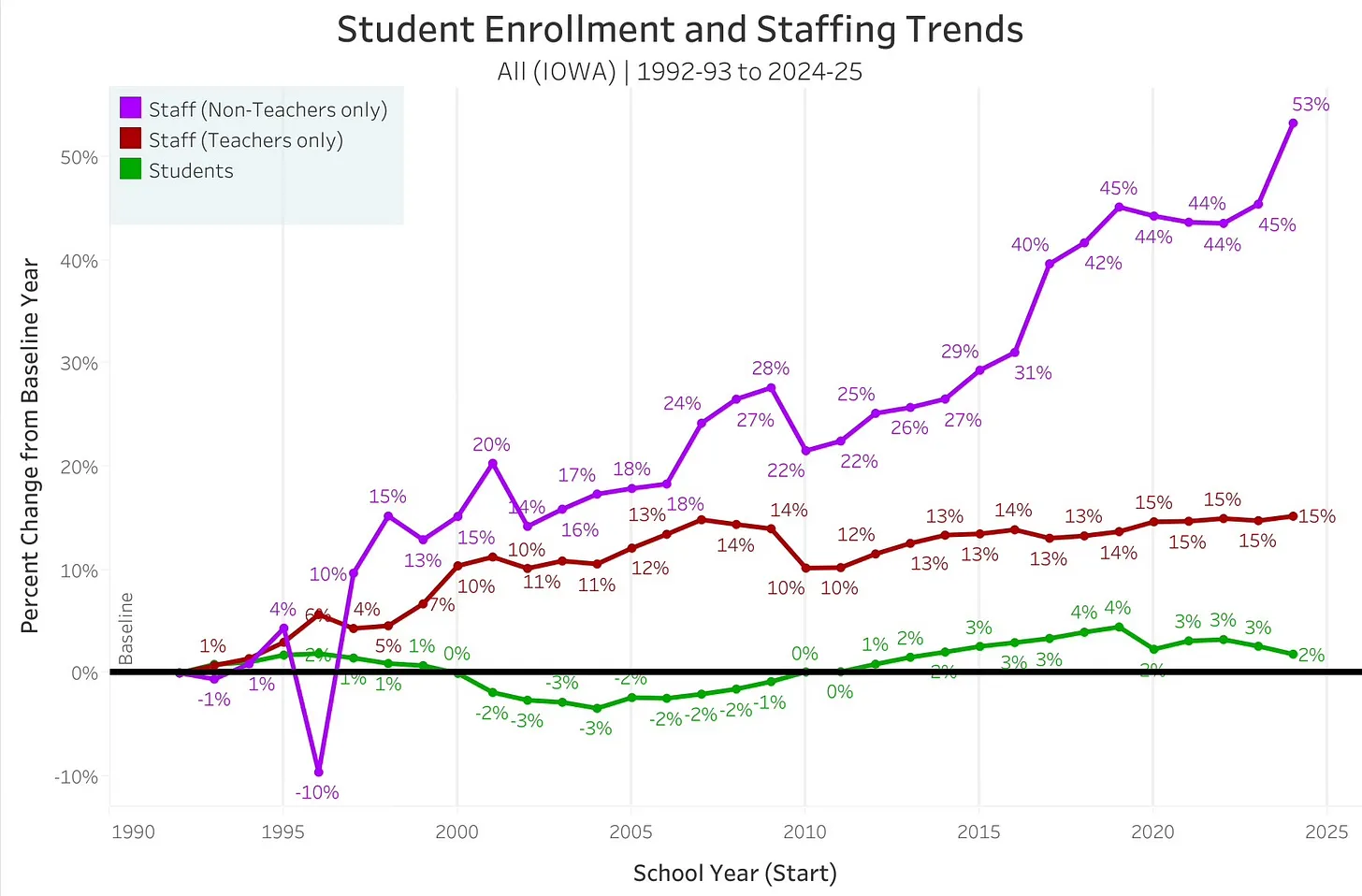
However if the critics’ claims were accurate, we would expect to see staffing levels fall in step with enrollment, right?
That’s not what has happened.
Instead, teacher counts have generally remained stable, and non-instructional staffing—roles such as administrators, coordinators, aides, and support personnel—has increased significantly, often by 30% to 70% or more over time.
In other words, many districts have already adjusted to fewer students without widespread reductions in staffing. In fact, the opposite is often true: schools today employ more staff per student than they did a generation ago.
This pattern is not limited to large districts. In mid-sized communities, staffing has continued to grow even where enrollment is stable or increasing. In smaller districts, staffing cannot shrink enough to match enrollment losses due to basic operational needs. The reasons vary, but the result is consistent across the state.
None of this means schools don’t face challenges, and it doesn’t suggest that every staffing increase is unnecessary. But it does raise an important point: the relationship between enrollment and staffing is not as rigid as critics often claim.
If Iowa’s school systems have already absorbed meaningful enrollment changes over time—while maintaining or even expanding staffing—it raises a fair question: why would smaller, incremental changes driven by family choice suddenly lead to the kind of disruption critics predict?
A more productive conversation starts with the data. And the data shows that Iowa’s education system is more flexible—and more complex—than the typical talking points suggest.