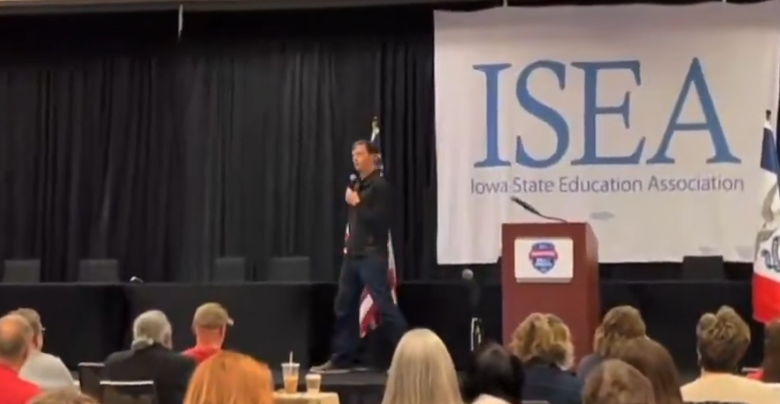
Video has surfaced of comments State Auditor Rob Sand, the Democratic nominee for governor, made at the Iowa State Education Association’s delegate assembly in April.
Discussing Iowa’s Students First Education Savings Accounts, which he continues to call school vouchers, Sand said:
“We have a school voucher system that has no oversight. Right? No oversight. That’s a slight exaggeration, there is a single rule. There’s one, right? So next to no oversight would be precisely accurate because one is next to zero. The only thing you can’t spend money on if you are a private school in the state of Iowa. The only thing you can’t spend public money on is that you can’t pay a rebate to parents. That’s it. If you want to buy booze with public dollars as a private school in the state of Iowa, you can do that. If you want to run a for-profit school and put every dollar that you get from taxpayers into your pocket as opposed to spending it on education, if you are a private school you can do that in the state of Iowa.”
Sand admitted that “no oversight” was an exaggeration. Calling it “next to no oversight” did not make it accurate.
Private schools are held accountable
Families may use ESA funds only at accredited Iowa nonpublic schools. Schools submit tuition and fees through the ESA system, and parents approve the payment. Tuition must be paid before any remaining funds can be used for other qualified educational expenses.
The Iowa Department of Education verifies eligibility and enrollment, may audit or review the program, recovers improper payments, and is responsible for preventing waste, fraud, and abuse. Knowingly making or receiving an unauthorized payment is a fraudulent practice.
Participating schools must remain accredited. State-accredited schools are subject to Department of Education monitoring, while independently accredited schools must meet the standards of an approved accrediting organization. ESA students must also take applicable state and federal assessments.
Parents choose the school
Sand speaks as though the state selects private schools and sends them unrestricted grants.
It does not.
The state establishes an account for an eligible student. Parents choose an accredited school, the school submits its tuition charge, and the parents approve the payment.
The school receives the money because a family selected it to educate their child.
Parents also provide accountability. They can question school leaders, decline to reenroll, or choose another school if the school fails to provide the education or environment it promised.
Sand’s description leaves parents out of the transaction and treats schools as though they were chosen by the state rather than by families.
The alcohol claim relies on fungibility
After a school legitimately receives tuition, Iowa does not require it to segregate that payment forever or seek state approval for every expense in its operating budget.
That is not unusual.
Private hospitals receive Medicaid payments. Child care providers receive public assistance payments. Private colleges receive publicly funded student aid. Government can verify eligibility, audit claims, recover overpayments, and punish fraud without controlling every later expenditure made by the provider.
The same distinction applies here. The state verifies eligibility, enrollment, tuition, and accreditation. It can investigate fraud and recover improper payments. It does not trace each tuition dollar indefinitely after the school has earned it.
A private school does not use a student’s ESA account to buy alcohol. It charges tuition for educating a student, and the parent approves that payment. Sand’s example turns the fungibility of money into an accusation of misconduct without offering evidence that misconduct occurred.
Iowa also conditions ESA participation on accreditation, not nonprofit status. A school’s corporate structure does not relieve it of the obligation to provide the education for which it charges tuition.
If Sand has evidence that a school collected ESA tuition without educating students or committed fraud, he should present it. Hypotheticals are not evidence.
A bad-faith argument to a friendly audience
Sand says he wants to be a governor for all Iowans. That standard should apply when he speaks to an audience that already agrees with him.
He can oppose ESAs. He can argue for additional reporting or financial controls. But dismissing the program as nearly unregulated and suggesting private schools may spend tuition on alcohol or pocket it without educating children is not an honest description of Iowa law.
Private school parents, teachers, leaders, and students are Iowans too. A candidate who wants to govern all of them should be able to disagree with their educational choices without caricaturing their schools before a sympathetic audience.