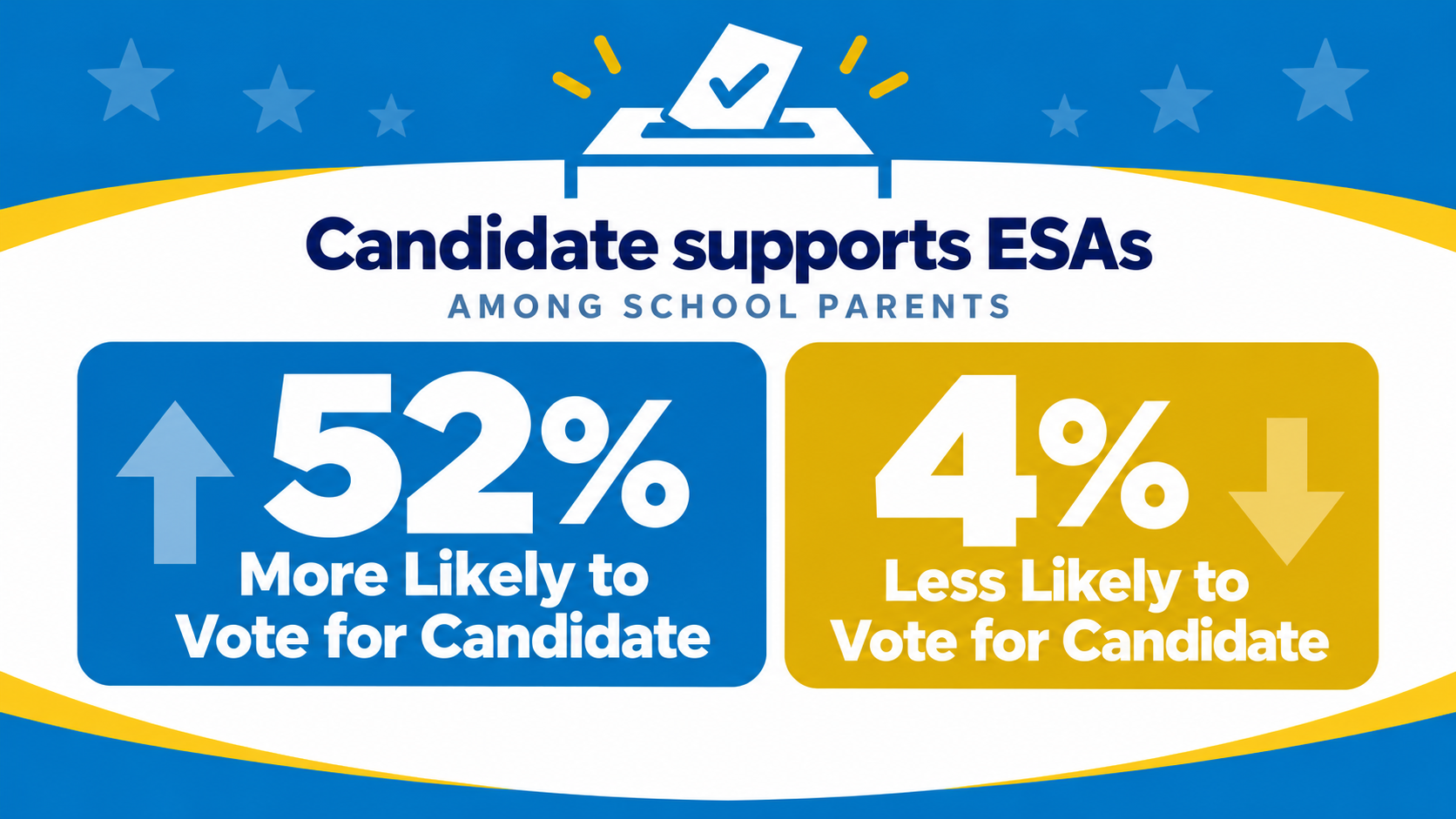
EdChoice released new national polling last week based on surveys conducted by Morning Consult in June, July, and August. The results show strong support for Education Savings Accounts among parents, including when voters are asked how a candidate’s position on ESAs could affect their vote.
Among all adults, 32 percent said they’d be more likely to vote for a candidate for governor or state legislature who supports ESAs, while 6 percent said they’d be less likely. Among school parents, the difference was much larger: 52 percent said more likely, compared with just 4 percent who said less likely. Another 28 percent said it would make no difference.
This is national polling, not an Iowa survey. But the response from parents isn’t close. Support for ESAs was far more likely to help a candidate than hurt one among the parents surveyed.
Parents Continue to Support ESAs
In August, 67 percent of adults supported ESAs and 11 percent opposed them. Among school parents, support reached 78 percent, while 9 percent opposed them.
That follows earlier EdChoice polling I wrote about, which found support increased when respondents were given a clear explanation of how ESAs work. In that survey, support among adults rose from 54 percent to 78 percent after a description, while support among school parents rose from 64 percent to 84 percent.
The September polling found the same basic pattern. Support among adults rose from 49 percent without a description to 69 percent with one.
When people start with only a vague idea of what an ESA is, clear or murky definitions can shape how they respond.
Parents Favor Broad Eligibility
The new polling also found that 76 percent of school parents agreed ESAs should be available to all families regardless of income or special needs.
That has a direct connection to Iowa, where Students First ESA eligibility is now universal for eligible K-12 students attending accredited nonpublic schools.
Federal Scholarship Tax Credit Support Outpaces Awareness
The survey also asked about the new federal tax credit for donations to scholarship-granting organizations. Sixty-four percent of adults and 77 percent of school parents supported their state participating in the program.
Awareness is much lower. Only 16 percent of adults and 27 percent of school parents said they had heard “a great deal” or “a lot” about the program, while 40 percent of adults said they had heard nothing about it.
Iowa has already opted into the federal program. Yet most parents nationally still know little about a program that more than three-fourths of them support.
Spending Numbers Change Opinions
The report also tested how information about public-school spending affects perceptions. Adults estimated that their states spend a median of $6,000 per public-school student, while school parents estimated $5,000. The report lists the FY2024 state average at $17,644.
Before seeing their state’s reported spending figure, 51 percent of adults said public-school funding was too low. After seeing it, that fell to 31 percent. Among school parents, the share fell from 57 percent to 33 percent. EdChoice notes that providing the government-reported spending figure reduced the “too low” response by 20 points among adults and 24 points among parents.
The poll doesn’t answer how much schools should spend. It does show that people answer the question differently once they know how much is already being spent
What the New Poll Adds
I pointed out earlier this month that the earlier EdChoice polling showed that explaining ESAs clearly changes how people respond to them. This new survey points to the next question: whether that support carries into politics.
For school choice advocates, the lesson is straightforward. Keep explaining what ESAs are and how they work. When parents understand the policy, support is not only broad. It can shape how they view the people asking for their vote.