Iowa’s Students First Education Savings Account program has changed who can realistically consider an accredited nonpublic school.
Families with enough money have always had choices. They could pay private-school tuition, hire a tutor, move to another district, or absorb other education costs. For many Iowa families, those options were financially out of reach.
ESAs have changed that. They have also produced plenty of claims about public-school funding, accountability, religious schools, rural Iowa, tuition, and who benefits from the program.
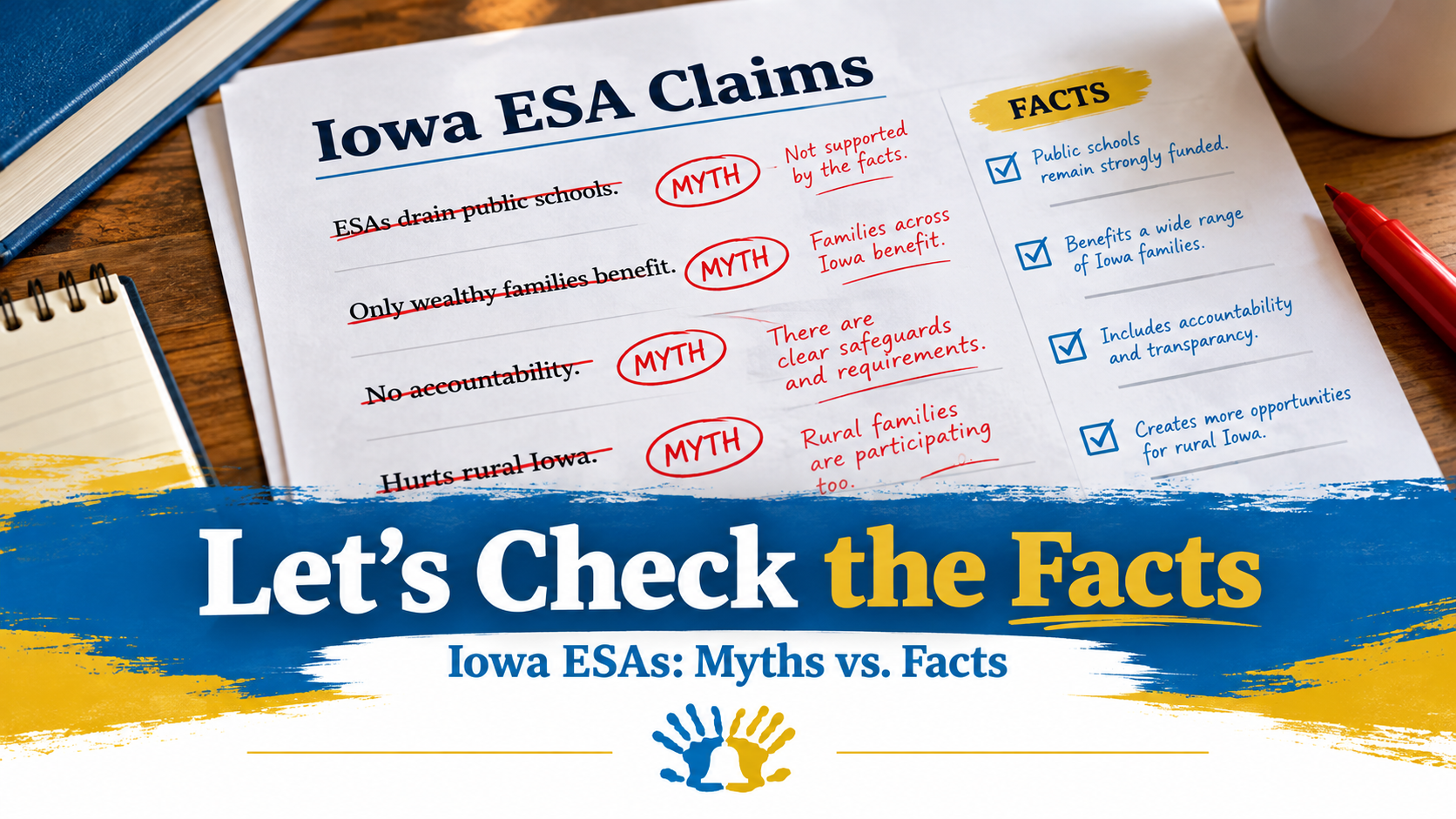
Here are 10 common myths about Iowa’s ESA program and the facts behind them.
Myth: ESAs drain money from public schools.
Fact: When a student leaves a public school for an accredited nonpublic school, the public school is no longer responsible for educating that student. The state funding associated with that student helps pay for his or her education at the new school.
But the resident public-school district does not lose every dollar associated with that student. Under Iowa’s funding formula, districts continue to receive categorical state funding generated by resident students attending nonpublic schools.
That distinction often disappears from the debate. A district may receive less money when it educates fewer students, but it also has fewer students to educate.
Myth: Private schools receiving ESA students have no accountability.
Fact: Iowa’s accredited nonpublic schools operate under a different system of accountability than public schools, but “different” does not mean “none.”
To participate in Iowa’s ESA program, a student must attend an accredited nonpublic school. Those schools must maintain state or state-recognized independent accreditation and comply with the requirements that apply to accredited nonpublic schools.
They also submit enrollment and other required information to the Iowa Department of Education, and ESA-related assessment accountability is reported to the state.
Then there is another form of accountability that should not be dismissed: parents can leave. A school that consistently fails its students cannot assume families will continue paying tuition simply because of their ZIP code.
Myth: ESAs are only a benefit for wealthy families.
Fact: Wealthy families did not need an ESA to have school choice.
Families with substantial financial resources could already pay private-school tuition or move to another neighborhood or district if they were unhappy with their child’s school.
The families whose choices were most constrained were those who could not afford another option.
Iowa’s ESA program is now available to eligible K-12 students regardless of household income. That does mean higher-income families can participate. It also means middle- and lower-income parents no longer have to prove they are poor enough before the state will help them choose a different education for their child.
Universal eligibility treats school choice as an educational option, not a poverty program.
Myth: Rural Iowa does not benefit from ESAs.
Fact: “Rural” does not mean “no choices.”
Many rural Iowa families already drive significant distances so their children can attend Christian, Catholic, or other nonpublic schools. For those families, an ESA can make the difference between being able to continue that education and having to give it up because of tuition costs.
School choice can also encourage new options. When families have greater purchasing power, opening or expanding a school becomes more financially realistic in communities that previously could not support one.
A rural family may not have a dozen schools nearby. That does not mean the choice they do have is unimportant.
Myth: School choice promotes discrimination.
Fact: An ESA does not assign children to schools or give the government authority to choose among them. Parents decide whether to participate and where to apply.
Nonpublic schools retain their individual missions, educational philosophies, admissions standards, and religious identities. Participation in the ESA program does not exempt them from state or federal laws that otherwise apply to them.
School choice also gives parents the ability to reject a school that is not a good fit and look for one that is. That power should not belong only to families wealthy enough to exercise it without help.
Myth: Using ESAs at religious schools is unconstitutional.
Fact: The U.S. Supreme Court has repeatedly rejected the argument that a neutral parental-choice program becomes unconstitutional simply because some parents choose religious schools.
The constitutional distinction is important. The state does not select a church or religious school and send money there to advance its faith. The state establishes an educational benefit, and parents independently decide where their children will attend school.
Cases including Zelman v. Simmons-Harris, Espinoza v. Montana Department of Revenue, and Carson v. Makin have established strong constitutional protection for religious participation in neutral school-choice programs.
Parents do not surrender their religious liberty simply because government helps fund education.
Myth: ESAs are an uncontrolled drain on Iowa’s budget.
Fact: ESAs have a cost.
For the 2026-27 school year, a full-year Iowa ESA is $8,148, equal to the regular state per-pupil funding amount. That is not the total amount spent from state, local, and federal sources to educate a student in Iowa’s public-school system.
Public districts also continue receiving certain categorical funding for resident students attending nonpublic schools.
Iowa is spending money to educate children through ESAs. The disagreement is over whether education funding should support only the government-operated system or also help parents choose an accredited nonpublic school.
Myth: ESAs cause private schools to raise tuition.
Fact: Private-school tuition can rise after an ESA program begins. That does not prove the ESA caused every increase.
Schools face the same pressures as other employers and organizations: salaries, health insurance, utilities, transportation, building maintenance, curriculum, technology, and other expenses all affect tuition.
Schools also operate in a competitive environment. Families can compare tuition, educational quality, culture, location, and other factors before deciding where to enroll.
An ESA is not a blank check for a school. Parents still decide whether a school is worth the cost.
Myth: School choice leaves children with disabilities behind.
Fact: No single school has the staff, facilities, programs, and expertise to serve every possible educational need.
That includes private schools. ESAs do not change that fact.
What ESAs can do is give parents another option. Families may find an accredited nonpublic school whose class size, instructional approach, environment, or available services better fit their child. After tuition and required fees are paid, remaining ESA funds may also be used for approved educational expenses through the program.
Iowa’s accredited nonpublic schools also remain subject to the disability-rights and special-education laws that apply to them.
The goal is to give parents more room to find the school that can best serve their child.
Myth: Parents can take ESA money and spend it however they want.
Fact: Iowa does not hand parents an $8,148 check.
ESA funds are administered through the state’s contracted platform. Tuition and fees must be paid through that system before remaining funds can be used for other eligible expenses.
Those additional purchases must qualify under Iowa’s rules and be made through the approved marketplace. The state’s contractor is responsible for financial transactions, compliance, fraud prevention, and other administrative safeguards.
Calling an ESA unrestricted cash simply does not describe how Iowa’s program works.
School Choice Is About Who Gets to Choose
No school is right for every child.
Some families will choose their local public school. Others will choose a Christian school, Catholic school, another accredited nonpublic school, a charter school, or homeschooling.
The purpose of school choice is not to declare one of those options superior for every family. It is to reject the idea that a family’s educational choices should depend primarily on its income or home address.
Parents know their children. They live with the consequences when a school is a poor fit, and they see the difference when a child finds the right one.
Iowa’s ESA program gives more of those parents the ability to act on what they know.