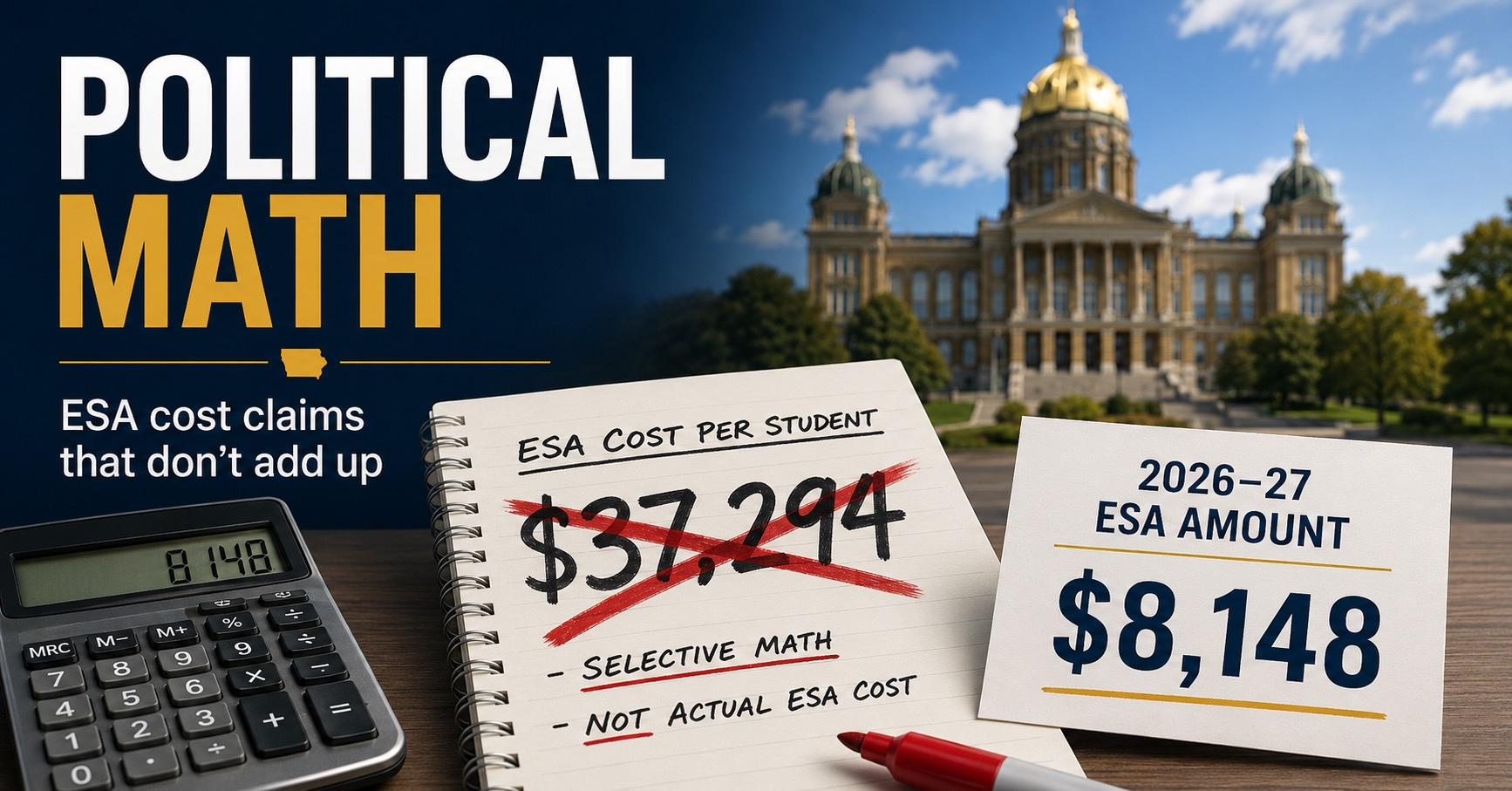
State Auditor Rob Sand’s office sent out a press release highlighting a report critical of Iowa’s Students First Education Savings Account program. One claim from the release has already drawn attention: Sand says the ESA program cost $37,294 “per new student.”
That number is not the cost of an ESA. It is political math.
The Cost of an ESA Is Not $37,294 Per Student
Sand’s own report estimates the FY26 cost of the ESA program at $329.6 million and says the program served 41,044 ESA users.
Sand reaches the $37,294 figure by taking the entire estimated cost of the ESA program and dividing it only by the 8,838 students he estimates are attending nonpublic schools above prior projections.
He leaves more than 32,000 ESA students out of the calculation while still including the money spent on them. That number may serve Sand’s political argument, but it is not the actual cost of an ESA. For the 2026-27 school year, the ESA amount is set at $8,148 per student—the same per-pupil amount provided to public schools through supplemental state aid. The figure is nowhere close to $37,294.
Sand reaches the higher number by taking the entire estimated cost of the ESA program and dividing it only by the 8,838 students he estimates are attending nonpublic schools above prior projections.
He leaves more than 32,000 ESA students out of the calculation while still including the money spent on them. That number may serve Sand’s political argument, but it is not the actual per-student cost of an ESA.
Sand Defines Access Too Narrowly
Sand’s calculation depends on a narrow definition of access. His report treats the ESA program as though it only provides access when a student enrolls in a nonpublic school who otherwise would not have done so.
Access is not limited to whether a family could have somehow enrolled a child in a nonpublic school without an ESA.
Access also includes whether a family can afford to stay there. It includes whether parents can enroll more than one child, whether they must rely on grandparents or private tuition assistance, whether they must take on debt, and whether their school choice is sustainable year after year.
Under Sand’s approach, a family already sacrificing to send a child to an accredited nonpublic school did not gain access when an ESA reduced that burden. That treats access as a one-time enrollment switch instead of an ongoing question of affordability and parental choice.
Parents do not ask only whether they can somehow make a school choice work. They also ask whether they can afford to sustain that choice responsibly for their child and family over time.
Universal Eligibility Was the Point
Sand’s report criticizes the program because many ESA students were expected to attend nonpublic schools even without the program. That misses the point of universal eligibility.
The Students First ESA program was not created as a transfer incentive for students leaving public schools. It was created to support eligible Iowa students whose parents choose an accredited nonpublic school.
Iowa does not fund public school students only after proving their families would have made a different educational choice without public funding. The state funds students because education has public value.
A child educated in an accredited nonpublic school is still an Iowa student. The value of that child’s education does not disappear because the family was already making sacrifices to choose that school.
The “Private Funds” Argument Is Selective
Sand’s report claims roughly $258.7 million went toward tuition that “could have, and likely would have, been paid for with private funds.” That sentence shows the assumption behind the analysis.
The Auditor is not just asking what the program costs. He is making a judgment about which families should receive help.
But “could have paid privately” is not the standard Iowa uses for public education funding. Iowa does not reduce public school aid because a family could afford another option, pay for tutoring, buy online courses, or provide other educational support.
We do not means-test the legitimacy of educating a child in a public school. We should not treat a child’s education as less worthy of support because his or her parents chose an accredited nonpublic school.
The question should not be whether parents were already committed enough to choose a nonpublic school. The question should be whether Iowa families should have meaningful access to the school that best fits their child.
The Report’s School List Has Problems
The report’s discussion of nonpublic schools has problems as well. Sand points to a significant increase in the number of nonpublic schools and includes a table of schools described as having opened during or after the 2022-23 school year.
Information provided by Dr. Josh Bowar, outreach director at the Iowa Association of Christian Schools (IACS), highlights a basic problem: the report does not consistently distinguish between a truly new school, an existing school that became accredited, an existing school with a new campus, or a school that remains open.
That distinction is important. A school that already existed and later became accredited is not the same thing as a brand-new school created because of ESAs. A new campus connected to an existing school is not the same thing as a new standalone school. A school that remains open should not be treated as closed.
According to information compiled by Bowar, several IACS schools listed in the report already existed but later became accredited. Those include Clear Lake Classical Academy, listed twice; Strong Roots Christian School; Victory Christian Academy; Hillside Christian School; Keokuk Christian Academy; Lighthouse Christian School; Joshua Christian Academy, listed three times; Gospel Assembly Christian Academy; Pathway Christian School; Coram Deo Classical School; Great River Christian School; HomeGrown Christian Learning Center; Mayflower Heritage Christian School; Two Rivers Classical Academy, listed twice; Mount Pleasant Christian School; Providence Classical Christian Academy; and Winterset Christian School.
The same information indicates that Tri-State Christian School, Siouxland Christian School, and Cedar Ridge Christian School were not brand-new schools in the way the report suggests. They were existing schools with new campuses or related school structures.
It also indicates that Clear Lake Classical and Empigo Academy are not closed, despite how they are treated in the report.
If a report uses school openings and closures to question Iowa’s ESA program, it should accurately describe the schools involved.
The report also raises concerns about independent accreditation without giving readers important context. IACS noted the newer schools in question are Christian or nonsectarian schools, which typically use independent accreditation. Catholic schools in Iowa have historically been more likely to use state accreditation. That helps explain the shift.
Independent accreditation is not a loophole or a lesser standard. It is an approved path for Iowa nonpublic schools under a framework established in state law that was signed by Governor Terry Branstad in 2013. The process requires schools to meet standards through approved accrediting agencies.
Bowar also notes that, in the experience of IACS schools, independent accreditation is often more rigorous and includes actual site visits.
Accreditation is only one part of the accountability structure around ESAs. Iowa’s ESA program also includes independent administration, verified spending through the Odyssey platform, annual eligibility review, enrollment requirements, fraud penalties, and state audit authority. In other words, school choice and accountability are not opposites. They are both built into the program. Iowa ACE has written more about the program’s accountability and oversight and how those safeguards work in practice.
That accountability record matters. Sand has criticized the ESA program repeatedly, but his office has not found fraud or abuse in ESA spending.
Without that context, the report leaves readers with the impression that independent accreditation is suspect. It is not. It is part of Iowa’s recognized accreditation framework.
The Political Context Is Relevant
Rob Sand is not only the State Auditor. He is also running for Governor, and he has been openly critical of Iowa’s ESA program.
Sand’s use of the material after his office issued the press release reinforces the point. After the report was released, he promoted news coverage highlighting the same criticisms of the ESA program that appeared in press release.
The Auditor’s Office has a legitimate role in reviewing public programs and asking whether taxpayer dollars are being spent properly.
However, Iowans should pay attention to how the numbers are presented. When the full cost of a program is divided by only one subset of students and then presented as though it reflects the cost of access, that is not neutral analysis. That is political math.
The same concern applies when the report raises questions about school growth and accreditation without making clear which schools are truly new, which were already operating, which are new campuses, and which are still open.
ESAs Are About Students, Not Projections
The ESA debate should be honest about costs, eligibility, accountability, and outcomes. It should also be honest about what the program does.
Students First ESAs help Iowa parents direct education funding to accredited nonpublic schools. They help new families access schools they could not otherwise afford, and they help existing families continue choosing schools that fit their children.
Reducing the program to “new students” ignores thousands of Iowa children whose families are receiving real educational support.
It also defines access in a way that excludes the very families universal eligibility was designed to include. A family does not lose its need for support simply because it was already trying to do what it believed was best for its child.
Iowa’s ESA program does not cost $37,294 per student. That number is a political calculation built on a narrow definition of access.
The real question is not whether every ESA recipient would have made a different choice without the program. The real question is whether Iowa believes parents should have more freedom and more flexibility in choosing the education that best serves their children.