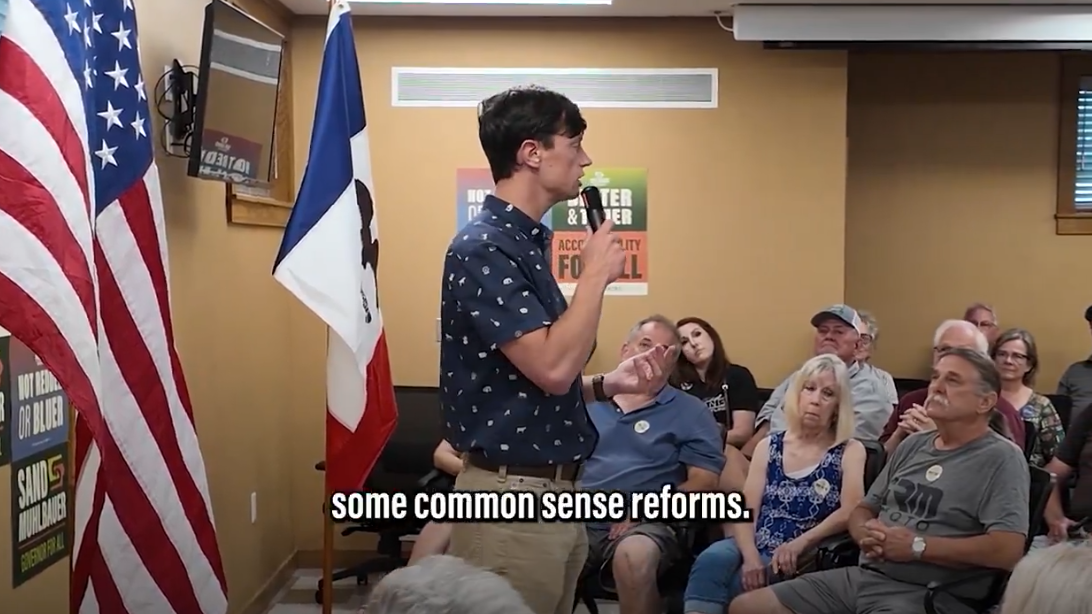
Iowa State Auditor and Democratic gubernatorial candidate Rob Sand wants Iowa voters to know he is not opposed to private schools.
In a June 28 post on X, Sand wrote:
“Let me make my position crystal clear: I’m not against private schools. I just want some common sense reforms to the private school voucher program.”
First, Iowa does not have a private school voucher program. It has an Education Savings Account program. Sand continues to call ESAs vouchers, but we have already explained why ESAs are not vouchers. I’m not going to belabor that point here.
I’m more interested in what Sand calls “common sense.”
In the video accompanying his post (watch below), Sand outlined three changes he wants to make to Iowa’s ESA program. None is as simple as he makes it sound.
“If you take public money, you got to take the public”
“Number one, if you take public money, you got to take the public. So if you’re going to take public money, you can’t pick and choose which students are coming in the front door.”
I addressed essentially this same argument last year in my Substack piece, “School Choice is about schools choosing students.”
School choice is about giving parents the ability to choose the school that best fits their child. It does not require every private school to admit every student who applies.
Private schools are private for a reason.
Many have a particular educational philosophy, religious identity, or school culture. Faith-based schools, in particular, may require parents or students to agree to a statement of faith or standards of conduct. Those requirements help preserve the mission and culture for which the school exists.
The principle works both ways.
Suppose someone opened a progressive private college-preparatory school built around DEI principles. The school could expect students and parents to support its philosophy and abide by its policies. If that school were properly accredited, students attending it could qualify for ESAs just as students attending Christian, Catholic, Lutheran, Jewish, or other accredited nonpublic schools do.
Would that still be school choice?
Of course.
Parents would decide whether that school was a good fit for their child. A family that fundamentally disagreed with the school’s mission presumably would look somewhere else.
Sand’s proposal also brushes past a serious constitutional question, particularly for religious schools.
The U.S. Supreme Court has spent years making clear that government cannot create a generally available benefit and then exclude religious institutions simply because they are religious or because they actually exercise their religion.
In Espinoza v. Montana Department of Revenue, the Court held that Montana could not exclude religious schools from a private-school scholarship program merely because they were religious. In Carson v. Makin, the Court went further, holding that Maine could not exclude schools because they would use tuition assistance to provide religious instruction. The Court emphasized that educating children in the faith lies at the core of a religious school’s mission.
The Iowa Association of Christian Schools has a helpful overview of those decisions and other cases involving parental rights, school choice, and religious liberty. Read IACS’ “Court Cases and the Legal Environment Around School Choice”. The article also discusses Our Lady of Guadalupe School v. Morrissey-Berru, where the Court recognized substantial constitutional protection for the autonomy of religious schools in carrying out their religious mission.
None of that means every possible admissions policy at a private school is constitutionally untouchable. But Sand is proposing something much broader when he says schools receiving ESA-supported tuition “can’t pick and choose which students are coming in the front door.”
What happens when an admissions requirement is tied directly to a school’s faith and mission? Can Iowa tell a Christian school that it must abandon religiously based admissions standards as the price of participating in a generally available parent-choice program?
That is not a hypothetical constitutional issue.
The Supreme Court has agreed to hear St. Mary Catholic Parish v. Roy, a case involving Colorado’s universal preschool program and Catholic preschools challenging state requirements that affect their ability to operate consistently with their religious beliefs. Oral arguments are scheduled for November 3. The case will give the Court another opportunity to address how far government can go in attaching conditions to participation in a generally available benefit program.
Sand’s “take the public” slogan makes all of this sound easy.
It isn’t.
There is also the much more practical problem of capacity.
Some private schools have waiting lists. They cannot put 25 students into a classroom built for 20 or admit another 100 students without teachers and classroom space to serve them.
In my earlier piece, I cited research from Florida showing that more than a third of parents who received but did not use a school-choice scholarship said their preferred school did not have enough space. That same basic reality exists in Iowa.
And expanding capacity costs money.
Which brings us to Sand’s second proposal.
“We can’t have them be jacking up tuition”
“Number two, we can’t have them be jacking up tuition by the full price of the voucher because if they do that, then that hasn’t made it any more affordable for anyone else.”
The phrase “jacking up tuition” does a lot of work here.
It makes it sound as though private schools see ESA dollars and simply raise tuition to capture the money.
That ignores how private-school tuition has historically worked.
I addressed this issue in March 2025 in “Nonpublic School Tuition Increases Are Necessary.”
For many Iowa nonpublic schools, tuition has never reflected the full cost of educating a student. At the time I wrote that piece, average public-school spending from state, local, and federal sources was $16,021 per student. Most private-school tuition was nowhere close to that amount.
Private schools have historically filled that gap through fundraising, church support, donations, scholarships, and other sources.
They also compete for teachers. They maintain buildings. They buy curriculum and technology. When enrollment grows, they need additional teachers and classroom space.
That requires money.
I also noted that the Iowa Association of Christian Schools had seen tuition increases among many of its member schools two to five years before my article. Those schools were not suddenly increasing tuition at unprecedented rates simply because ESAs became available.
Sand’s argument overlooks a fundamental difference between public and private school financing.
Public schools do not operate on state per-pupil funding alone. They receive money from state, local, and federal sources. When districts need new or renovated facilities, they can also ask taxpayers to approve bonds or levies.
Private schools cannot.
Yet Sand apparently wants the state to look at the ESA amount and decide how much a private school should be permitted to increase tuition, regardless of the school’s actual expenses.
That starts looking a lot less like “common sense” and a lot more like government price controls.
It also creates an obvious contradiction between Sand’s first two proposals.
He wants private schools to take more students.
But when those schools need to hire more teachers, improve salaries, renovate classrooms, or construct additional space to serve those students, he wants to limit their ability to raise tuition.
You cannot demand expansion and then hamstring schools financially when they try to expand.
As I wrote before, expansion costs money.
That hasn’t changed.
“I want to put the income limits back on it”
“And number three, I want to put the income limits back on it. We have a $1.3 billion budget deficit right now every single year. And yet we are paying people in the state of Iowa who make more than a million bucks a year to pay for their private school tuition that they were going to be paying for anyway. We shouldn’t be doing that. We should go back to income limits on it so that it’s actually going for the kids that want it.”
We have already addressed Sand’s income-limit proposal in detail in “Rob Sand’s Income Test.”, so I won’t repeat the entire argument here.
The problem is straightforward. Iowa made ESA eligibility universal because educational choice should not disappear when a family crosses an arbitrary income line.
Those parents pay taxes too.
A universal program recognizes that parents, not politicians, should decide which educational setting best serves their children.
Restoring an income limit would move Iowa backward from that principle.
Is this really “common sense”?
Sand is free to oppose parts of Iowa’s ESA program. But attaching the words “common sense” to his proposals does not settle the argument.
His first proposal could interfere with the ability of private schools to preserve their mission, maintain legitimate admissions standards, and account for their actual capacity. For religious schools, a blanket requirement to surrender control over admissions could also raise serious First Amendment questions.
His second would hamstring private schools financially while ignoring the multiple revenue sources available to public schools.
His third would reverse Iowa’s decision to make school choice available to every eligible family rather than just those politicians decide deserve it.
And the first two proposals work against each other.
Sand wants private schools to take everybody while limiting their ability to raise the money necessary to serve more students.
That isn’t common sense.
It is a recipe for making private schools less private, less financially sustainable, and less able to meet the growing demand from Iowa families.