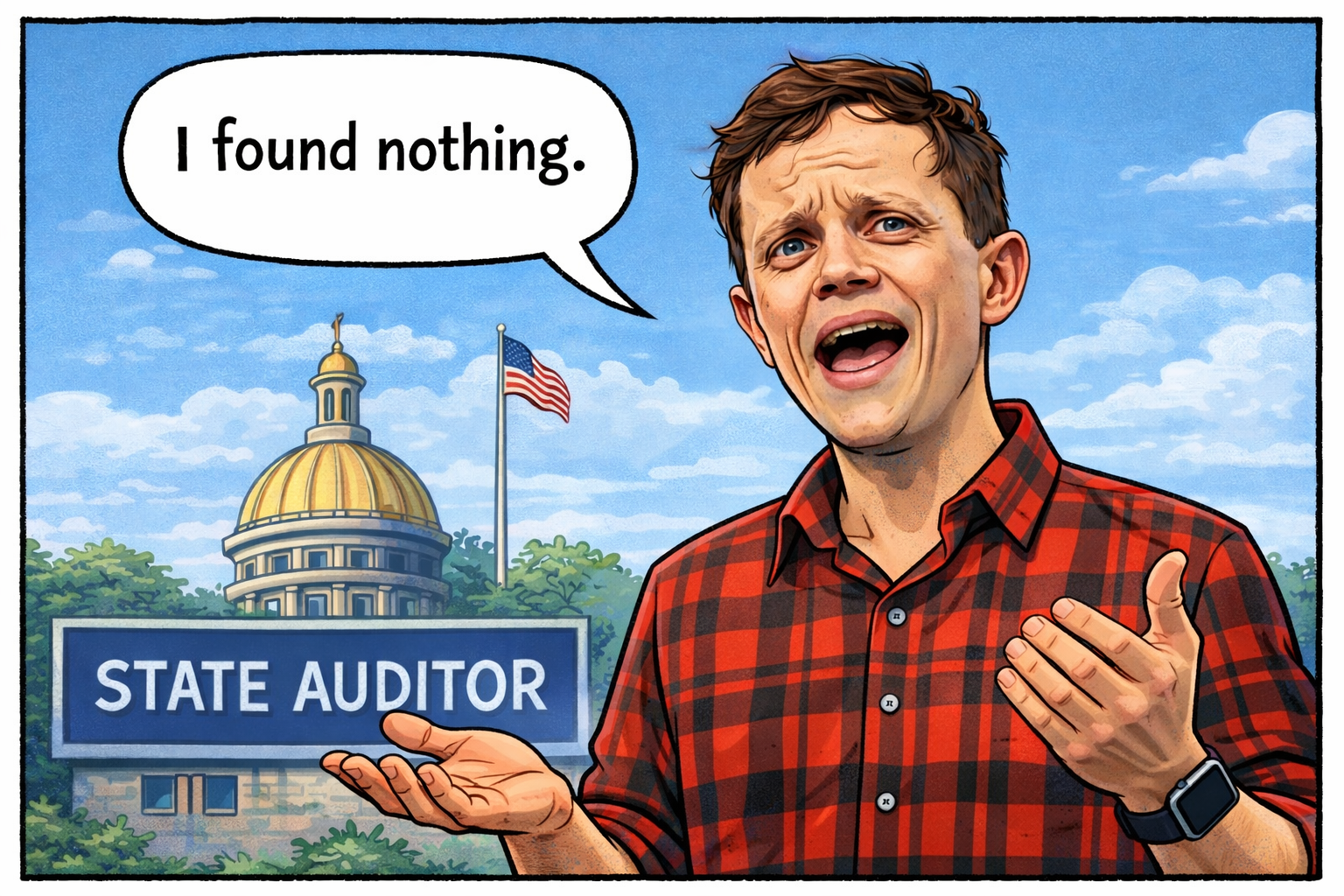
Iowa State Auditor Rob Sand has made the ESA program a centerpiece of his criticism of Governor Reynolds’ administration—and a recurring theme in what is widely expected to be his 2026 gubernatorial campaign. His core claim: that the administration has blocked his office from auditing $100 million in ESA spending, leaving taxpayer dollars unaccountable.
It’s a serious charge. It’s also not what the record shows.
When you look at what Sand’s office actually found—and what it didn’t find—a very different picture emerges: a document timeline dispute that Sand has chosen to present as a cover-up, and an audit that, when completed, turned up no evidence of misspent ESA funds.
What Sand Said
In February 2025, Sand held a press conference in which he accused the Departments of Education and Revenue of refusing to hand over documents related to income eligibility verification and fraud controls for the ESA program. His framing was stark:
“This administration won’t let us audit the controls on $100 million in your tax money going out on the governor’s program. We cannot say that it has appropriate and reasonable controls for waste, fraud and abuse,” he said.
The implication was clear: ESA dollars were flowing out the door with no meaningful oversight, and the administration was actively preventing scrutiny.
By early 2026, his office’s position had shifted somewhat. Sand acknowledged that documents were eventually provided—but complained they arrived in November 2025, roughly six months after his office’s May 2025 request. He argued the delay prevented his team from expanding the audit’s scope before a statutory reporting deadline.
What the Reynolds Administration Said
The Reynolds administration pushed back on Sand’s characterization directly. Kraig Paulsen, Director of the Iowa Department of Management, said the documents were released once auditor staff clarified how the program’s growing size affected its “materiality” for audit purposes—something he said Sand’s office had not adequately explained in the original request.
“Had he explained some of the things that he articulates in the letter to us, when he originally asked, then the whole dialogue would have changed,” Paulsen said as reported byThe Iowa Capital Dispatch.
In other words: the administration’s position was not that the ESA program is exempt from audit. It was that Sand’s initial request lacked the context needed to justify the scope he was seeking. Once that context was provided, the documents followed.
The administration also pointed out that Sand was seeking information beyond the agreed scope of the statewide Annual Comprehensive Financial Report (ACFR)—and that expanding that scope required a separate engagement letter, which Sand’s office had not initiated
What the Audit Actually Found
Here is the detail Sand’s press conferences tend to omit: his office audited ESA-related financials and found no spending irregularities. No misspent funds. No evidence of families or schools abusing the program.
The findings were procedural—concerns about document timelines and the scope of the audit engagement. That’s a legitimate administrative issue worth resolving. It is not evidence that Iowa’s ESA program lacks accountability, and Sand has not presented it as such when pressed on specifics.
Sand’s own auditors also concluded that the ESA program’s size made it “material” to the state’s annual financial report—and proceeded to include it in their audit accordingly. The program was not shielded from review. It was reviewed
The Political Context
None of this happens in a vacuum. Sand is the only Democrat currently holding statewide elected office in Iowa. He has opposed the ESA program publicly and consistently. He is also running for governor.
That doesn’t automatically make his concerns wrong. Auditors should receive documents in a timely manner, and the state should take that obligation seriously. But it does make the gap between what Sand’s audits have actually found—nothing—and how he describes the program—as a $100 million black box—worth examining carefully.
When a politician running for governor calls a political opponent’s signature program unauditable, and his own audits turn up no evidence of misuse, the appropriate response is skepticism—not alarm.